Firelite Tech Support

  • Subscribe to our RSS feed.
  • Twitter
  • StumbleUpon
  • Reddit
  • Facebook
  • Digg

Friday, 15 June 2012

California, Stoves, "Campfire" Permits, and ESBIT

Posted on 22:04 by Unknown
I live in California in the United States.  I thought I'd comment about what is and is not permissible with respect to stoves, fires, and fuels in the backcountry here.

Unfortunately, there are a welter of jurisdictions including state parks, national parks, city parks, national forests, county parks, and Bureau of Land Management areas.  Each of these may have their own rules and restrictions.  Even different units of the same overarching agency will have differing rules.

However, there is one thing that is generally required in California across the various jurisdictions:  the California Campfire Permit.  Basically, outside of a developed campground, to have any kind of fire (a wood fire or a camp stove), you have to have a campfire permit.  And, yes, you read that right; you have to have a permit in order to operate a camp stove in the backcountry.  Based on the name, you would think a campfire permit would be for wood fires alone, but, no, a campfire permit is for any type of fire, including all backpacking type stoves.

It's easy to get a permit; just click on the above link, print it, fill it out, and sign it.  You don't have to go to a ranger station, pay a fee, take a test, or anything like that.  I think they just want you to have the regulations in front of you.

A campfire permit generally allows one to use a woodfire, charcoal fire, or "chemical" stove, but each local jurisdiction places additional restrictions as to where fires and what fuels are permitted.    Wood and charcoal fires are generally the most restricted with many jurisdictions confining wood fires to developed campgrounds only.  With respect to those restrictions, gas and pressurized liquid fueled stoves are always OK in state and federally controlled backcountry areas, but I have seen local cities prohibit even gas and pressurized liquid fuel stoves (e.g. the City of Monrovia).  Jellied petroleum (I assume they mean Sterno type stoves) is also permitted (but who the heck uses a Sterno stove?).

Alcohol and hexamine (e.g. ESBIT) stoves are generally lumped in with wood fires and are typically more restricted.  Alcohol and wood stoves are prohibited in many backcountry areas in California, especially in Southern California.  The rule of thumb is:  Where wood fires are permitted, alcohol stoves are permitted; where wood fires are not, alcohol stoves are not.   Unfortunately, the Forest Service lumps ESBIT in with alcohol and wood even though ESBIT is very different (and very safe).  See the Appendix below for further discussion on this topic.

SUMMARY
  • Print and carry a California Campfire Permit
  • Gas and pressurized liquid fuel stoves are almost universally permitted for backcountry use
  • Expect greater restrictions on wood and charcoal fires
  • Alcohol and ESBIT stoves are generally lumped in with wood fires -- and are more heavily restricted
  • Generally, in an area where wood fires are permitted, alcohol and ESBIT stoves are permitted; where they are not, alcohol and ESBIT stoves are not.  
  • Always check with each local jurisdiction as to the specific rules governing your type of stove or fire 
I realize it's a bit complicated, but I hope that helps.

HJ

APPENDIX
So why so many restrictions on alcohol and ESBIT type stoves?  Well, the San Bernardino National Forest website has a helpful Q&A section from which I quote:


Q:  Why are jelly petroleum-fueled stoves okay and campfires aren’t?
A:  Jelly petroleum-fueled stoves can be extinguished by putting a metal lid over the container. This makes their use much safer than campfires. Ashes or hot briquettes can blow outside of the fire pit; these embers can easily start a wildfire. Also, visitors might discard ashes or hot charcoal briquettes before they are completely cool, which could cause vegetation to ignite later after they are gone. Wood, charcoal, or any solid fuel fires are not allowed within the San Bernardino National Forest outside developed campgrounds, picnic areas, yellow post sites, and special use permitted sites in agency-provided fire rings or designated sites at any time of the year.

So, based on the Forest Service's above answer, a fuel that can be reliably extinguished, whose flame cannot be spread by wind, and does not leave behind by-products that might start a fire is an appropriate fuel for backcountry use.  Based on the Forest Service's own answer, I'd say that ESBIT is an appropriate fuel for backcountry use.  Burning ESBIT can be reliably extinguished by blowing it out; ESBIT flames are not spread by wind, and ESBIT leaves behind no by-products that might start a fire.  I think ESBIT gets lumped in with wood fires simply because the land agencies aren't familiar with it.  Bureaucracies being what they are, it probably won't happen, but it sure would be nice if the various agencies that have jurisdiction over backcountry areas would take a second look at ESBIT.

With alcohol stoves, I understand the restrictions a little bit more (note that I said "understand" not "like").  Alcohol can spill and spread flames, and many alcohol stoves cannot be extinguished once lit.
Read More
Posted in California Campfire Permit | No comments

Tuesday, 5 June 2012

Blog Status 5 Jun 2012

Posted on 21:06 by Unknown
Rumors of my demise are greatly exaggerated. :)

 Yes, I still exist even though I haven't been blogging much lately. My new job requires a good deal of commuter travel. Commuting more than 2 hours a day in heavy Southern California urban traffic seems to have sapped my energy to the point where blogging isn't very appealing, even blogging on a fascinating subject like stoves.

Time also is far more dear. With my old job, I had in effect an extra 2.5 hours per day. Those extra 2.5 hours per day are now a thing of the past. Still, I hope to periodically post some updates, and who knows my job situation may change again.  I'm still getting out and dealing with interesting stoves, stoves which I think are worthy of your attention, stoves that I'd like to share with you.

My first priority is of course to keep my family fed, clothed, and housed. My stove blog will never make any real money, and I'll never come anywhere close to being able to earn a living through blogging, so my blog is and will remain just a hobby. My family must of course come first. I do hope you understand and will bear with me.  

In order to whet your appetite, here are a few previews of coming attractions:
The new Primus OmniLite Ti (Right)
Baking on the trail.
Snow melting 101
The Snow Peak white gas stove (a personal favorite)
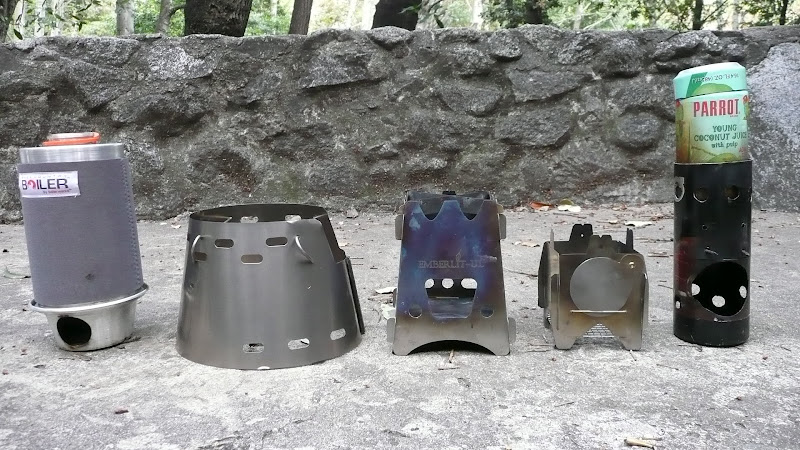
Wood stoves compared

Stay tuned!

HJ
Read More
Posted in | No comments

Friday, 13 April 2012

Gas in Cold Weather: The Myth of "Fractioning"

Posted on 15:27 by Unknown
I'd like to dispel a myth that's out there: the myth of "fractioning."

Supposedly, if you've got a typical canister of gas (i.e. containing propane and some form of butane), in cold weather (temps below the vaporization point of all but the propane), only that fraction of the fuel that is propane will burn. Supposedly.

Here's an example of the myth: You have a canister that is 70/30 butane/propane. Propane vaporizes at -44F/-42C; butane at +31F/-0.5C. Now, say it's 20F/-7C out. According to the myth, only 30% (that fraction of the mix that is propane) will burn off.

That's the myth.  What really happens?  Well, take a 70/30 canister out in 20F/-7C weather and burn it until it's empty. Now weight it. You'll find the weight is lower than if only 30% of the fuel had burned off.

Why? Well, when you mix liquid hydrocarbons, they combine to form a blend. The blend has properties that lie "between" the properties of the constituent fuels. For example, the boiling point of a 70/30 blend of propane and butane will have a boiling point between -44F/-42C and +31F/-0.5C. The math is non-trivial, but if you know the formulae, you can calculate the resultant boiling point. In this case, a 70/30 blend has a boiling point of about 0F at standard pressure (1 atmosphere/1013mBar).

Now there is a little bit of a catch to all this. This "blend" of liquid hydrocarbons in a canister of gas (recall that there's so much pressure inside a cansiter that our gasses liquefy) still has two distinct molecules in it: Propane molecules (C3H8) and butane molecules (C4H10). The propane molecules have a higher vapor pressure than the butane molecules. In other words, the propane molecules tend to vaporize more than the butane molecules in the blend. How does a canister typically work? Well, you draw vapor off the top, and then more of the liquid portion of the fuel vaporizes to replace the drawn off vapor. If the propane is what most readily vaporizes, then the propane will be removed from the blend more rapidly than the butane. This is called "preferential" vaporization. Because the propane is vaporizing faster than the butane, your blend will change over time as the canister empties.  As the blend changes, so will the vaporization point.  Toward the end of the life of the cansiter, all the propane will be gone and only your secondary fuel will remain.

Uh, isn't this "preferential" vaporization the same as "fractioning?"

No, not at all. Remember that the myth of fractioning calls for only the propane to burn leaving behind all of the butane. What happens in reality is that the blend vaporizes some butane and some propane throughout the life of the canister until the propane is gone. Yes, you will reach a point where all of the propane is gone and only butane remains, but the fact of the matter is that you will be burning off far more fuel than if only propane alone were burning.

With fractioning (if it were true), you could only burn of 30% of the fuel in a 70/30 canister. With preferential burning, you burn more like 75% of your fuel before you wind up with nothing but butane left (the actual amount burned varies with altitude and temperature of course).

This brings up two important points:
1. Don't use canisters with regular butane in cold weather. Eventually all your propane will burn off, leaving behind whatever else is in your canister. If you've got isobutane (vaporizes at +11F/-12C) as your secondary fuel you've got a 20F (10C) degree advantage over a canister that has regular butane (vaporizes at +31F/-0.5C) as its secondary fuel.

2. Stoves that can handle running with the canister upside down (inverted canister stoves) draw fuel off the bottom of the canister. If you're drawing fuel off the bottom, you're only drawing liquid. If you're not drawing vapor, then it doesn't matter which fuel vaporizes at what rate. Inverted canister stoves start and end with the same fuel blend. If you start with 70/30, you end with 70/30, and your vaporization point stays low, allowing you to run your stove in much colder weather than a conventional upright (screws onto the top of the canister) gas stove. With an inverted canister stove, you can burn all of your fuel in cold weather (assuming that your blend's vaporization point is sufficiently high for the weather).

So, there you have it: What's really going on in that canister of yours in cold weather. I hope this puts the myth of "fractioning" to bed.

I thank you all for joining me on another Adventure in Stoving,

HJ

Related articles and posts:
  • Cold Weather Tips for Gas Stoves
  • What's the Best Gas for Cold Weather?
  • Canisters, Cold, and Altitude:  Gas in a Nutshell
  • Gas in Cold Weather:  The Myth of "Fractioning"
  • Canister Stoves 101:  Thread Care
  • Gas Blends and Cold Weather Performance.  (Why not just use propane?)
  • Gas Stoves: How Cold Can I Go?
  • The "SuperGnat"  (Camping Gaz or threaded canisters with one lightweight stove)
  • Backpacking Gas Canisters 101    
  • Gas in Extreme Cold:  Yes or No?
  • Stoves For Cold Weather I (Upright canister stoves) -- Seattle Backpacker's Magazine
  • Stoves for Cold Weather II (Inverted canister stoves) -- Seattle Backpacker's Magazine
Read More
Posted in cold, cold weather, gas, propane | No comments

Monday, 9 April 2012

Wood Cooking Clean Up

Posted on 18:34 by Unknown
Ever find yourself holding back on using a particular pot or pan for wood cooking?  I mean they do get pretty darned black if you use them on a wood fire.  Sometimes I hesitate to use a pot I usually use with gas or alcohol on a wood stove because I don't want to get the darned thing all black.

Well, hold back no longer.  There's a simple trick out there that can get your pot clean again after cooking on a wood fire.  The trick?  Dish soap.
Putting a thin layer of dish soap on a pot before cooking with wood helps tremendously with clean up
Yep, that's right, just simple old dish soap.  Smear on a thin layer before you head out.  A little dish soap makes clean up go so much easier.

Why bother you say?  It's just going to get dirty again?  Well, and that is one way to handle it.  You could just pack your blackened pot in a sealed plastic bag so soot doesn't get all over.  But I use my pots with multiple fuels (gas, liquid, alcohol, wood, and hexamine).  A coating of soot will insulate your pot from the flame, and you'll have to use more fuel to heat things up.  So, for me, when I'm done with some wood cooking and want to switch to another fuel, I clean my pot.

How well does it work?  Let's have a look.

I'm just going to use an old scrubber type sponge here.  You probably could use steel wool on a steel or titanium pot.  A word of warning:  Whatever you use to clean, you're going to get it very dirty.  You'll probably want to throw the scrubber sponge away afterwards so it won't get other things dirty.  Either that or you'll have to have a designated scrubber sponge for really dirty clean ups.

So, here's my pot.  Pretty black.  Just waiting to get all over the inside of my pack, and pretty inefficient since heat is going to have to penetrate that coating before it heats the pot.
A rather sooty pot that has been used on a wood fire
Let's try a quick scrub with some soap and hot water.
A few scrubs, and bare metal starts to appear
Say, that's not too shabby for a few quick scrubs with an old scrubber sponge.  Makes quite a difference.

Let's try to clean the worst spot, the bottom of the pot.
Quite a marked contrast between the cleaned and the uncleaned sections of the pot
Hey, now that's quite a difference between the upper half of the pot that I've cleaned and the lower half that I have not.

Now, I'd be a liar if I said that it came off like magic.  Nope; it just doesn't work that way.  It takes some real elbow grease.  And, even when I finished cleaning the pot, there were still some little spots of black in the cracks and such.  But try cleaning a pot that's been used for wood fired cooking without first putting some dish soap on it.  The soot is not going to come off anywhere near as easily.

So there's your wood cooking clean up tip:  Smear a little dish soap on the exterior of your pot before you start cooking.  You'll be glad you did come clean up time.

Thanks for joining me on another Adventure In Stoving,

HJ
Read More
Posted in cleaning wood soot, wood cooking clean up | No comments

Sunday, 8 April 2012

Blog Status, 8 Apr 2012

Posted on 12:13 by Unknown
Well, I've found a job.  After about a quarter of a year's worth of unemployment, I'm quite grateful.   There's just one catch:  The work is in the next county over, and I'll be commuting, at least for the short term, a couple of hours each way.  Necessarily, my hiking and therefore my blogging is going to be greatly reduced.  Gone will be the mid-week evening hikes to test stoves.  Also, chores and such that I could do on a weeknight will perforce be pushed to the weekend, reducing my time there.  A pity, but work is necessary if I'm to feed and house my family and all that.

So, just an update.  I intend to keep blogging, just at a less frequent rate.

I thank you for joining me on these Adventures in Stoving,

HJ
Read More
Posted in blog status | No comments

Friday, 6 April 2012

How Much White Gas Do I Need?

Posted on 12:17 by Unknown
How much white gas should you bring on your trip?  That's actually going to depend a lot on your style of cooking, your stove, the conditions, etc, but let's take a look and see what we can come up with.

The white gas stove I've used the most is my MSR Whisperlite.  I'll be using my experience with my Whisperlite to generate the numbers that follow.
My MSR Whisperlite
A word about style:  On most of my backpacking trips, I keep cooking fairly simple.  Most of the time, I'm boiling water for re-hydrating foods and making hot drinks.  I almost always have tea in the morning and cocoa in the evening.  I normally boil at least two cups and more typically three cups per boil.  Simmering for the most part is kept to a minimum, but I do simmer sometimes to re-hydrate things at higher altitudes.  I don't typically have a hot lunch, but I almost always have a hot breakfast and supper.

Over time, I've noticed that I use something on the order of 1.5 fl oz (44ml) of white gas on a solo trip per day.  For two people, I find my usage is something on the order of 2.25 fl oz (67ml) per day.  If I'm melting snow, I figure on roughly doubling those amounts.  These amounts include fuel used for priming.  These amounts are the amounts I expect to use.  Particularly in winter, you should plan for the unexpected.  I typically bring an extra day or two's worth of fuel on winter trips.

So what does that equate to in terms of fuel bottles?  There are a lot of different sized fuel bottles out there.  I'll list some common sizes, and you can hopefully adjust from there.

A note on fuel bottles:  MSR, Sigg, Primus, Optimus, Snow Peak, and Brunton fuel bottles all have the same threads and are generally interchangeable.  However, you should always test your particular stove with the particular fuel bottle you intend to use before your trip.  My Primus pump fits in my MSR fuel bottle, but the opposite is not true:  My MSR pump does not fit in my Primus bottle.  The threads on the Primus bottle are compatible, but the threads start down too low in the neck of the bottle for my MSR pump to engage.

Most manufacturers recommend that you use only their fuel bottles with their stove.  That's fine, and you can't go wrong with that, but that recommendation is more about legal liability than it is about the technical requirements of running a stove.  Generally, any fuel bottle designed by a reputable stove company for use with a pump should be fine, provided that it has compatible threads.
An Optimus Nova stove in use with an MSR fuel bottle.  Works just fine.
I would not use "no name" fuel bottles or drink bottles as a fuel bottle for a pressure stove.  Note: Coleman and Soto fuel bottles have proprietary threads and are not interchangeable with any other brands.

Now, fuel bottles:  I'm going to list MSR's bottle simply because that's what I have a lot of.  MSR has three bottles:
10 fl oz "working" capacity, 11 fl oz total capacity (300ml, 325ml)
20 fl oz working capacity, 22 fl oz total capacity (600ml, 650ml)
30 fl oz working capacity, 33 fl oz total capacity (900ml, 975ml)

Note that there is a "working" capacity and a total capacity.  Why two different capacities?  Well, when you run a pressure stove, you need some air space in the bottle for it to work right.  MSR always marks their bottles with a fill line.  Do not fill past the fill line.  The capacity up to the fill line is the working capacity.  The capacity up to the physical top of the bottle is the total capacity.  For running a stove, use the working capacity.  For storage and transport, you can fill the bottle to the total capacity.

Examples (assuming 1.5 fl oz/47ml per day)
10 fl oz (~300ml) = 6.5 days
20 fl oz (~600ml) = 13 days
30 fl oz (~900ml) = 20 days

For almost all of the trips that I've done, a 20 fl oz/600ml bottle has been plenty.
A 20 fl oz/600ml MSR bottle in use with an MSR XGK II stove
The only time I've really wanted a 30 fl oz/900ml bottle was when I was doing a lot of snow melting.  At home, I use 30 fl oz/900ml bottles for storage.  If I were going to buy just one bottle, I'd probably buy a 20 fl oz/600ml sized bottle.  For short trips, I'd carry a bottle with a lot of empty space in it.  for longer trips, I would fill the bottle.  If all you take is short or weekend trips, you might consider a 10 fl oz/300ml size.  If I did a lot of winter  trips, or wanted bottles for storage, the 30 fl oz/900ml size make a lot of sense.

Now, these are my numbers.  The only way you're going to know how much fuel you're going to use is to get out there and do some trips.  These numbers are somewhat conservative by design, but you might want to carry a little extra fuel until you get it dialed in.  Be aware that in windy and cold conditions, your fuel usage may go up.  Hopefully these numbers will give you some rough idea of how much fuel you might want to bring along.

I thank you for joining me on another Adventure in Stoving,

HJ
Read More
Posted in coleman fuel, MSR super fuel, petrol, petrol stove, super fuel, superfuel, white gas, white gas stove, white gasoline | No comments

Wednesday, 4 April 2012

Canister Stoves 101: Thread Care

Posted on 11:05 by Unknown
Don't screw on your canister stove too tight.

Why not?

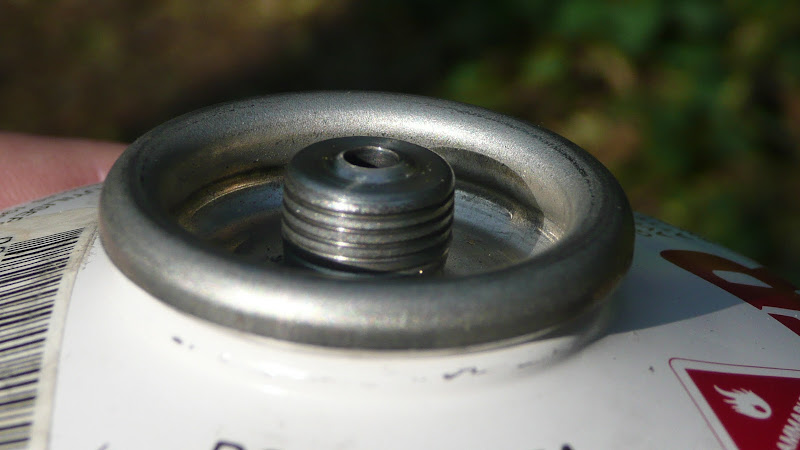
Well, take a look at the threads on a canister some time.
Notice how the threads do NOT go all the way out and form a sharp line.  These threads are rounded off.  That means that the only part of your stove's threads that are going to grip the canister is the very tip (very outer edge) of your stove's threads.

Whoa!  Wait a minute.  Do you mean to tell me that the only thing holding the stove on to a canister is the edge of the threads?

Yes, that's what I'm saying.  And that's a fairly thin bit of metal.  Too much pressure will put excessive wear on your stove's threads.  Heavy users have reported threads so worn that stoves have literally fallen off the canister.  Once your stove's threads are so worn that they no longer grip the canister, you're pretty much out of luck; you have to replace the stove.

So, Canister Stove Thread Care 101:
  • Don't over tighten.  If you're getting good gas flow and no leaking, that's tight enough.
  • Use the little cap on your canister.  Sure, it's a hassle to keep track of the little plastic cap, but dirt, sand, etc on the canister's threads could screw up that nice  stove you've got.  
  • Keep the threads clean on your stove.  Keep it wrapped in a bandana or something to keep crud out of the threads.  I normally keep my canister stove wrapped up and in my cook pot when it's in my pack.  Some stoves come with a little pouch or case which may be a good alternative if you don't store your stove in your pot.  Don't wrap your stove in something that sheds a lot.
  • Inspect the threads on your canister.  If there's damage on the canister threads, get a new canister (if available).  It's not worth it to use a damaged canister which might screw up your stove.
  • Do NOT cross thread.  Make sure you thread the canister on correctly and that it turns smoothly.  If it feels "funny," stop and check.  Cross threading is a great way to damage your stove.
I generally don't recommend lubricating the canister threads because crud might be more prone to stick to the lubricant, but I do know some people who lubricate the canister threads with silicon grease to prevent binding.  Perhaps there may be some advantage to this approach.

The main thing to remember with canister stoves is that a little care goes a long way.  Keep things clean, don't over tighten, and be careful how you screw on the canister.

I thank you for accompanying me on another Adventure in Stoving.

HJ


Related articles and posts:
  • Cold Weather Tips for Gas Stoves
  • What's the Best Gas for Cold Weather?
  • Canisters, Cold, and Altitude:  Gas in a Nutshell
  • Gas in Cold Weather:  The Myth of "Fractioning"
  • Canister Stoves 101:  Thread Care
  • Gas Blends and Cold Weather Performance.  (Why not just use propane?)
  • Gas Stoves: How Cold Can I Go?
  • The "SuperGnat"  (Camping Gaz or threaded canisters with one lightweight stove)
  • Backpacking Gas Canisters 101    
  • Gas in Extreme Cold:  Yes or No?
  • Stoves For Cold Weather I (Upright canister stoves) -- Seattle Backpacker's Magazine
  • Stoves for Cold Weather II (Inverted canister stoves) -- Seattle Backpacker's Magazine
Read More
Posted in butane stove, canister gas, canister stove, cartridge stove, gas cartridge, Gas stove, isobutane stove, threaded canisters | No comments
Newer Posts Older Posts Home
Subscribe to: Posts (Atom)

Popular Posts

  • The Kovea LPG (Propane) Adapter
    I recently picked something up that turns out to be pretty useful:  A Kovea LPG (Propane) Adapter.  This adapter allows one to run a standar...
  • DIY Alcohol Stoves -- Basic Design Principles
    In a pinch, you can use just about anything to make an alcohol "stove" out of.  Really, there are only two criteria: Your stove ha...
  • The New Lightweight Champion
    Until recently, the Monatauk Gnat (aka the FMS-116t, aka the Olicamp Kinetic Ultra) was the world's lightest canister stove at 48g/1.7oz...
  • Primus Omnifuel vs. MSR Whisperlite Universal
    There are some really nice expedition class stoves out there on the market right now.  One of the really nice features that's come out i...
  • Stove of the Week: Hank Roberts Mini Stove, Mark III
    I happen to like my old Hank Roberts stove, a stove that dates back to the 1960's. It's in very nice condition. I have the Mark I...
  • Fire Safety -- Alcohol vs. ESBIT?
    Currently, there are three active wildfires burning within a one hour drive of where I live.  None of these that I know of were caused by a ...
  • The Hank Roberts Stove -- With a Proper Canister
    What's one of the most enduring designs of gas stoves? The Hank Roberts mini stove.  It's compact design truly makes it a pocket sto...
  • The Epicurean Ti ESBIT Stove
    ESBIT is a common backpacking fuel.  ESBIT consists of hexamethylenetetramine, which is usually just called hexamine .  ESBIT is generally ...
  • Blog Status, 1 May 2013
    Personal News Out of work again.  Sigh.  In my industry, IT, it seems that most work these days is project based work.  I just completed a ...
  • Stove of the Week: The Borde Stove
    Stove of the Week:  The Borde stove I've been blogging about lightweight winter capable stoves for the last three weeks (the Coleman Xt...

Categories

  • 100% propane
  • 12-10
  • 12-10 burner
  • 2012
  • adapter
  • alcohol burner
  • alcohol fuel
  • alcohol stove
  • all fuel
  • all fuel stove
  • Appalachian Trail
  • AT
  • back country
  • backpacker
  • backpacking
  • backpacking canister
  • backpacking espresso
  • backpacking fuel
  • backpacking fuel prices
  • backpacking stove
  • beginner stove
  • best alcohol
  • best gas cold
  • best gas cold weather
  • best stove
  • blended fuel
  • blog status
  • boil
  • borde benzin brenner
  • borde bomb
  • borde stove
  • BPL
  • BPL Firelite
  • BPL Firelite 550
  • Bush Buddy
  • Bush Buddy Ultra
  • bushbuddy
  • bushbuddy ultra
  • butane
  • butane adapter
  • butane refill
  • butane stove
  • Caldera
  • Caldera Caddy
  • caldera cone
  • Caldera Cone Ti-Tri
  • Caldera Inferno
  • California Campfire Permit
  • Camp 5
  • camping
  • Camping Gaz
  • canister
  • canister cold
  • canister explosion
  • canister formats
  • canister gas
  • canister gas cold
  • canister refilling
  • canister stove
  • canisters
  • cartridge refill
  • cartridge stove
  • cat can stove
  • Cheap Deals
  • cleaning wood soot
  • Clikstand
  • cold
  • cold weather
  • cold weather gas
  • Coleman
  • coleman fuel
  • Coleman Max
  • Coleman PowerMax
  • Coleman Xpedition
  • Coleman Xpert
  • Coleman Xtreme
  • Crux
  • denatured alcohol
  • disk stove
  • EFI
  • Esbit
  • Espresso Star
  • ethanol
  • ethyl
  • Evernew
  • expedition
  • extreme cold
  • fast boil times
  • FeatherFire
  • fuel
  • fuel cube
  • fuel gauge
  • fuel price
  • fuel prices
  • fuel quantity
  • fuel tablet
  • gas
  • gas cartridge
  • gas cold weather
  • gas explosion
  • gas formats
  • gas gauge
  • gas refill
  • Gas stove
  • Gaz
  • gear
  • gear review
  • Gerry Stove
  • getting started
  • GigaPower
  • Gnat
  • GS-100
  • Hank Roberts
  • Hank Roberts Mini Mark III
  • Hank Roberts Mini Stove
  • heat exchanger
  • heat shield
  • HEET
  • hexamine
  • hexie
  • hiking
  • hybrid stove
  • Inferno option
  • integrated canister stove
  • Internationale
  • inverted canister
  • inverted gas
  • isobutane stove
  • JetBoil
  • JetBoil Cooking
  • JetBoil danger
  • JetBoil failure
  • Jetboil fry pan
  • JetBoil melt
  • Jetboil omelet
  • Jetboil omelette
  • Jetboil pan
  • JetBoil problem
  • JetBoil Sol
  • JetBoil Sol Ti
  • jetboil Sumo
  • KB-1006
  • kerosene
  • Kovea
  • Kovea Camp 4
  • Kovea Camp 5
  • Kovea Moonwalker
  • lighter
  • liquid feed
  • liquid feed gas
  • liquid fuel
  • Mark III
  • Max
  • melted heat exchanger
  • methanol
  • metho
  • metho stove
  • meths
  • meths stove
  • methyl
  • methylated spirits
  • micro regulator
  • micro rocket
  • microregulator
  • microrocket
  • mini bull
  • Mini Bull Designs
  • Mini Mark III
  • Mini Stove
  • minibull
  • Monotauk
  • Monotauk Gnat
  • Moonwalker
  • MSR
  • MSR canister
  • MSR Espresso Star
  • MSR micro rocket
  • MSR microrocket
  • MSR pocket rocket
  • MSR pocketrocket
  • MSR Rapidfire
  • msr reactor
  • MSR Simmerlite
  • MSR super fuel
  • MSR SuperFly
  • MSR Titan kettle
  • MSR Whisperlite
  • MSR whisperlite universal
  • MSR Windpro
  • MSR Windpro II
  • msr xgk
  • muka
  • muka od1-np
  • muka od1np
  • muka stove
  • Muka ストーブ
  • multi fuel
  • multifuel
  • n-butane
  • new
  • Nion 3
  • Nova
  • od-1np
  • od-1R
  • od1np
  • od1r
  • Omni Fuel
  • Omnifuel
  • open jet stove
  • Optimus
  • Optimus Crux
  • Optimus Nova
  • pack stove
  • PackaFeather
  • petrol
  • petrol stove
  • piezo
  • piezoelectric
  • pocket rocket
  • pocketrocket
  • pots
  • Powermax
  • PowerMax refilling
  • practical
  • pre shaker jet
  • pre-heat loop
  • pre-Katadyn
  • price
  • Primus
  • Primus Omnifuel
  • propane
  • propane adapter
  • propane backpacking
  • propane stove
  • radiation shield
  • Rapidfire
  • reactor
  • refill canister
  • refilling backpacking
  • refilling butane
  • remote canister
  • remote gas
  • review
  • side laying canister
  • simmer control
  • simmering
  • simmering alcohol
  • Simmerlite
  • snow melting
  • Snow Peak
  • SOD-300
  • SOD-371
  • SOD300
  • SOD371
  • Sol
  • Sol Ti
  • solid fuel
  • soto
  • soto microregulator
  • soto muka
  • soto od-1R
  • soto od1-np
  • soto od1np
  • Soto pocket torch
  • stove
  • stove fuel
  • stove review
  • super fuel
  • SuperFly
  • superfuel
  • SuperGnat
  • threaded canisters
  • ti wing
  • Ti-Tri
  • Tibetan Ti Wing Stove
  • tips
  • Titan kettle
  • titanium
  • top mount canister stove
  • top mounted canister stove
  • Trail Designs
  • Trangia
  • two burner
  • ultralight
  • Universal gas
  • unsafe
  • upright canister stove
  • warning
  • whisperlite
  • whisperlite universal
  • white gas
  • white gas stove
  • white gasoline
  • wind
  • Windpro
  • Windpro II
  • windscreen
  • windscreens
  • wood burner
  • wood cooking clean up
  • wood gas
  • wood gasification
  • wood stove
  • XGK
  • xgk ii
  • Xpedition
  • ボルドーバーナー

Blog Archive

  • ▼  2013 (18)
    • ▼  May (2)
      • Fire Safety -- Alcohol vs. ESBIT?
      • Blog Status, 1 May 2013
    • ►  April (5)
    • ►  March (6)
    • ►  February (5)
  • ►  2012 (54)
    • ►  September (2)
    • ►  June (3)
    • ►  April (5)
    • ►  March (12)
    • ►  February (13)
    • ►  January (19)
  • ►  2011 (65)
    • ►  December (15)
    • ►  November (13)
    • ►  October (7)
    • ►  September (3)
    • ►  August (5)
    • ►  July (2)
    • ►  June (3)
    • ►  May (2)
    • ►  April (1)
    • ►  March (5)
    • ►  February (5)
    • ►  January (4)
Powered by Blogger.

About Me

Unknown
View my complete profile